QIA.Service – Modular Digitalization Interface (2020–2024)
The aim of the project was to collect data from the QIAStatDx production lines validated form in the Azure Cloud to provide. A modular interface architecture was developed for this purpose - divided into core, plugins and a configuration layer.
Related pages: QIAGEN – QIAStatDx Large Scale Line · Manufacturing Radar
Architecture & Topology
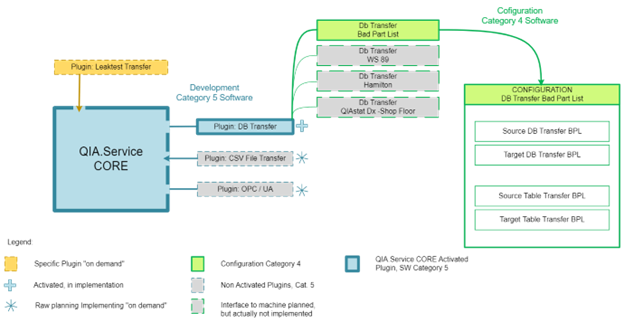
Figure: Modular structure of the interface. Divided into core development, plugin development and a configuration layer to adapt the plugins to local requirements. This means that rollouts that only require configuration can be implemented in a validation-friendly manner.
Requirements Engineering
The requirements work in this project was particularly complex: stakeholders from production, QA and IT sometimes had competing goals - at the same time, all requirements had to be specified in accordance with validation.
Elicitation
- Stakeholder workshops with production, QA and IT side
- Requirements gathering for OPC/UA client, cloud connection and plugin architecture
- Technical concepts: Generic programming, virtualization, Docker deployment
Modelling
- Interface specification for each plugin (input/output, error cases, configurability)
- Traceability from requirements to qualification documents
- Risk Matrix: Prioritization and risk classification
Software
architecture
- Modulares Plugin-System: Core + Plugins + Configuration Layer
- Separation of core development and configuration-based rollouts – as a basis for lean validation cycles
- Windows Service / Docker-Deployment
Development
- Validiertes Backend „Analytics Interface" (.NET 6 / Azure / Docker)
- Plugins: DbTransfer (MSSQL/MariaDB), CSV, OPC/UA, Computer Vision, Azure Blob / Event Hub / IoT Hub
- R&D-Plattform „Manufacturing Radar" (C# / ASP.NET Core / Razor Pages)
- 3rd Level Support
Validation
Validability was not a downstream step, but rather an architectural design goal: The configuration layer enables rollouts without re-validation of the core.
Strategy
- Validation concept: Separation of core and configuration changes as a basis for risk-based qualification
- ALCOA+ compliant data provision in the cloud
Documents
- URS – User Requirements Specification
- SDS – Software Design Specification
- FDS – Functional Design Specification
- DQ / IQ / OQ / PQ – qualification documents
- Risk Matrix
Technical environment
- .NET 6.0
- Windows Service / Docker
- Azure DevOps
- Azure Cloud (IoT Hub, Event Hub, Blob Storage)
- MSSQL / MariaDB
- OPC/UA