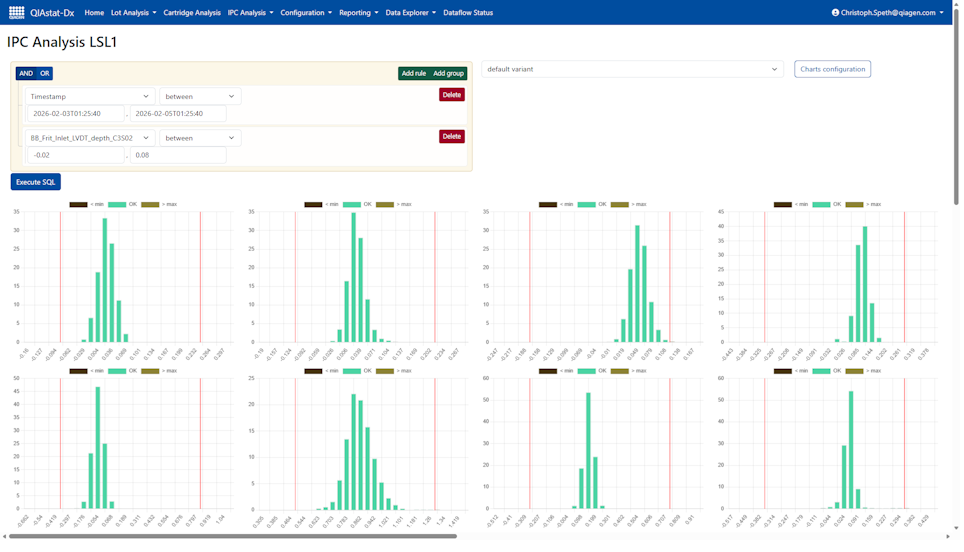
Manufacturing Radar
With this in-depth process knowledge, I was well prepared to support initiatives aimed at harmonizing processes and reducing scrap rates and downtime.
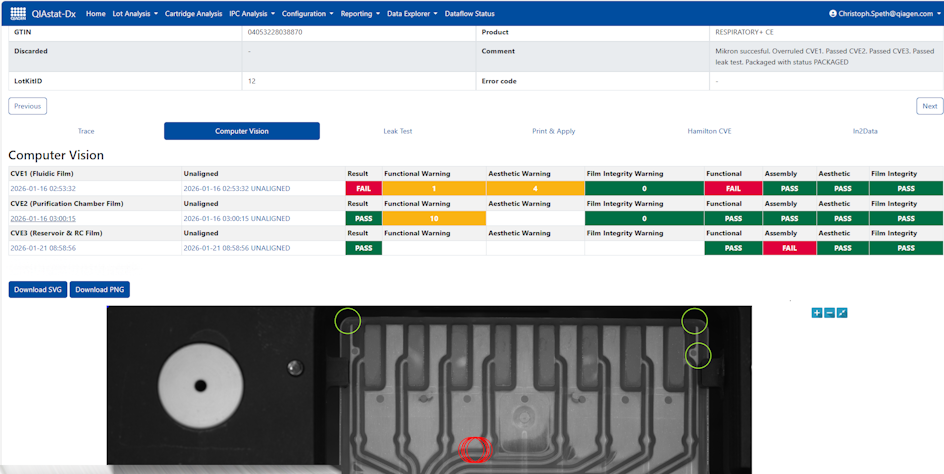
The approach was to use IPC data to build an information landscape that enabled insights into quality and manufacturing issues at the individual unit level, as well as the identification of trends across production batches.
The Manufacturing Radar is an ASP.NET application designed to fulfill this requirement.
A wide range of IPCs are used, including various types of computer vision workstations, leak testers, scales (Mettler-Toledo / LabX), REA barcode verifiers, and Hamilton pipetting robots with vision add-ons.
Data of different types and technical characteristics are consolidated in the Manufacturing Radar into a unified information entity.
At a later stage, a decision was made to transition from small-scale lines to the high-throughput environment of a large-scale production line.
On behalf of QIAGEN, I served as the project lead for the data interface.
The MIKRON system is equipped with highly differentiated sensor technology, delivering a wide variety of production and process data.